Do Not Worry

Many of us find it easy to worry about things in our life. Matters that relate to our jobs, families, finances, and more can cause anxiety. But Jesus told his followers, “Do not be worried about your life” (Matthew 6:25). Sometimes this is easier said than done. But notice what Jesus said about this subject:

“For this reason I say to you, do not be worried about your life, as to what you will eat or what you will drink; nor for your body, as to what you will put on. Is not the life more than food, and the body more than clothing? Look at the birds of the air, that they do not sow, nor reap nor gather into barns, and yet your heavenly Father feeds them. Are you not worth much more than they? And who of you by being worried can add a single hour to his life?” (Matthew 6:25-27).

In these verses, Jesus asked three questions. As the master teacher, He was able to ask questions in a way that was more instructive than inquisitive. Notice the three points Jesus made that will help us deal with anxiety.

1. There are more important things to consider (Matthew 6:25) – Yes, food and clothing are important. But a few verses later Jesus explained how we should order our priorities: “But seek first His kingdom and His righteousness, and all these things will be added to you” (Matthew 6:33). We need to put a priority on spiritual things. We must recognize that the physical things we worry about are only temporal.

2. We are valuable in the sight of God (Matthew 6:26) – God provides for the birds of the air. Jesus said that in God’s eyes we are worth much more than birds. If God will provide for the needs of animals, He will provide for our needs.

3. It does no good to worry (Matthew 6:27) – We cannot prolong our lives by worrying. Another translation mentioned one adding height to his physical body. No good is accomplished by worrying. Good will be accomplished when we consider the situation and act appropriately. Anxiety hinders us from doing this.

When you are tempted to worry, remember what Jesus taught. Make sure you have your priorities in the proper order. Know that you are valuable in the sight of God. Recognize that worrying will do no good to help the situation that is causing you the anxiety.

Remember also the benefit of prayer. Paul wrote, “Be anxious for nothing, but in everything by prayer and supplication with thanksgiving let your requests be made known to God. And the peace of God, which surpasses all comprehension, will guard your hearts and your minds in Christ Jesus” (Philippians 4:6-7).

Let us keep all of these things in mind. Do not let anxiety hinder you from serving God. Put your faith and trust in Him that He will take care of you, as long as you “seek first His kingdom and His righteousness” (Matthew 6:33).

–by Andy Sochor, Eastside church of Christ in Morgantown, KY.

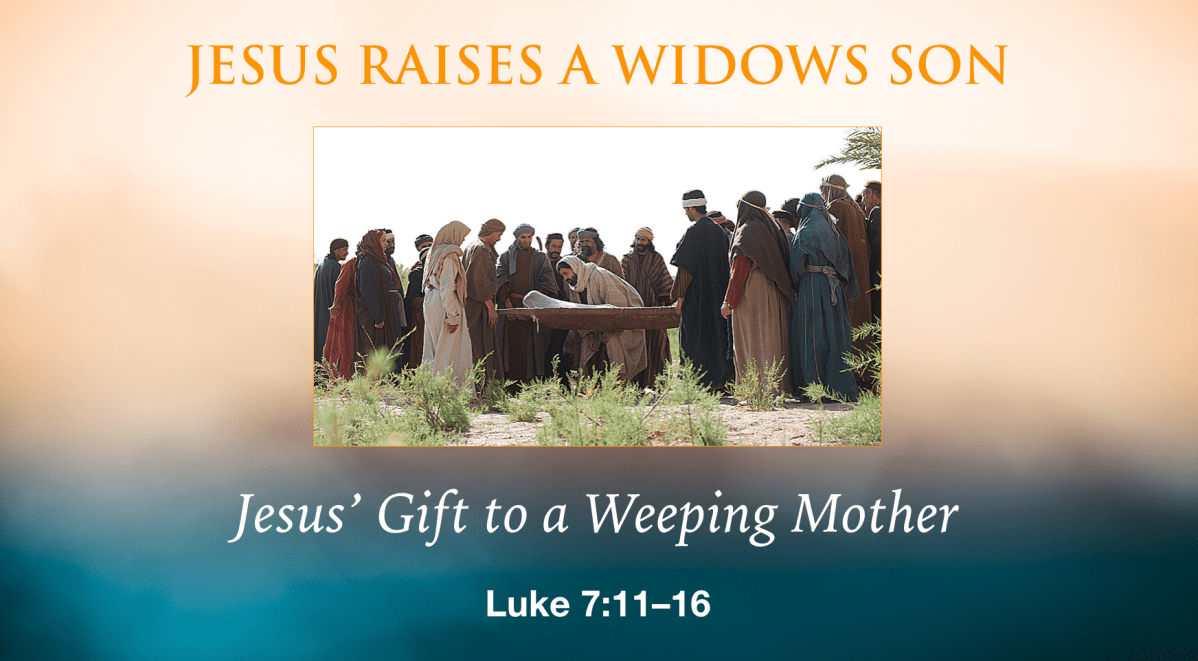
A Widow’s Son is Raised

Jesus’ Gift to a Weeping Mother

Sermon for Sunday May 10. Lesson 10 in a series on the miracles of Jesus.

It has been said that tears are words that cannot be spoken.
“What happens to our tears? We wipe them away… We assume they evaporate somewhere into the great universe.” (Lowell F Johnson)
But the Bible tells us what happens to the tears of God’s children:
“You number my wanderings; Put my tears into Your bottle;
Are they not in Your book? (Psalm 56:8)
The Lord cares –– He Knows every tear that is shed, and the reason for every tear.
In our text today (Luke 7:11-17) the Lord sees the tears of a mother, and tells her “weep not.” Then He gives her a gift to take her tears away––her son alive from the dead!

“Beloved, I pray that you may prosper in all things and be in health, just as your soul prospers.”

3 John 2

Dear brothers and sisters,
It is week 7 of the Covid-19 coronavirus quarantine. Isolation is never easy, and this has been difficult for all of us. You are in my heart and my prayers, and I hope you are healthy in mind and spirit. I pray that we can assemble with one another soon to worship God together. During this time be sure to remember there is a river that flows from the throne of God, that makes glad the city of God (Psalm 46). Nothing that happens to us on earth will ever change that fact––that God is on His throne and He is in control.
Your fellow servant, Bill Turner

A Widow’s Son is Raised

AUDIO | TEXT PDF

Jesus’ Gift to a Weeping Mother


Center

“. . . and he who believes on Him will by no means be put to shame” (1 Peter 2:6).

GOD WILL NEVER DISAPPOINT US. He is the only secure, unchanging center around which we can order our lives, and in which we can ground our peace. He is an infallible point of reference.

To say that God will never disappoint us is not to say that we will never be disappointed. We may sometimes be disappointed that God does not do as we wish. But this is not because of any objective failure of faithfulness on His part. It comes rather from a subjective failure on our part to understand God’s wisdom, His methods, and even His love.

God is often described in the Scriptures in terms of things that are solid and immovable. One figure is that of a rock. David, for example, said, “Truly my soul silently waits for God; from Him comes my salvation. He only is my rock and my salvation; He is my defense; I shall not be greatly moved” (Psalm 62:1,2).

But another interesting figure is that of an anchor. In the New Testament, Christians with a wavering faith were urged to hold on to their hope: “This hope we have as an anchor of the soul, both sure and steadfast” (Hebrews 6:19). And they were reminded that God’s promise is backed up by His oath, “that by two immutable things, in which it is impossible for God to lie, we might have strong consolation, who have fled for refuge to lay hold of the hope set before us” (Hebrews 6:17,18).

Our frequent frustrations in life result, more often than not, from having an unstable center. In selecting our end-all-and-be-all, we select some fairly shaky things, often with tragic results. And even when we suppose that God is our center, our faith often turns out to be not in God Himself but in certain earthly blessings that He’s allowed us to have temporarily. But like Job, we need to love God for His own sake, even when His wisdom withdraws particular blessings from us. And like Paul, we need to be grounded in God and able to say, “For this reason I also suffer these things; nevertheless I am not ashamed, for I know whom I have believed and am persuaded that He is able to keep what I have committed to Him until that Day” (2 Timothy 1:12).

“Change and decay in all around I see; O Thou who changest not, abide with me” (Henry F. Lyte).

Gary Henry – WordPoints.com

Healing a Man with a Withered Hand

The Tragedy of Turning Blessings into Burdens (Mark 3:1-6)

Sermon for May 3, 2020 – Lesson 9 in a series on the Miracles of Jesus, where the power of Christ is creating conflict among the Pharisees and scribes of the Law.

I pray that you are safe, healthy and drawing closer to the Lord. Thank you for continuing in this sermon series on the Miracles of Jesus. There are so many spiritual lessons we find in these amazing accounts of the work and ministry of Christ. In this text we see Jesus healing a man in the synagogue with a withered hand on the Sabbath day. A conflict arises, creating a tense situation: Why are the Pharisees angry at Jesus for healing on the Sabbath? Does Jesus break the Sabbath law like the Pharisees accuse Him of doing? What can we learn from the miracle of Jesus and the mistakes of the Pharisees and Scribes of the Law?

Below is the audio and PDF text of the lesson. Also this week’s bulletin article: The Set of Our Sails, about being pro-active in choosing the direction of our life. Don’t forget the Bible Class Lesson on the Apostle Thomas: The Man Who Became Convinced By Doubting. And be sure to check out the info-graphic showing the Fear Zone, Learning Zone, and Growth Zone we commonly experience in trials: Who Do I Want to Be During the Covid Crisis?

Please continue to lift one another up in prayer. May God bless you and keep you and give you peace (Numbers 6:24-26).

Your fellow servant in the Lord,
Bill Turner

SERMON FILES: AUDIO | TEXT PDF

The Tragedy of Turning Blessings Into Burdens (Mark 3:1-6)

The Set of Our Sails

“And Elijah came to all the people, and said, ‘How long will you falter between two opinions? If the Lord is God, follow Him; but if Baal, follow him.’ But the people answered him not a word” (1 Kings 18:21).

WHEN IT COMES TO GOD, WE WON’T MAKE MUCH PROGRESS IF WE “FALTER BETWEEN TWO OPINIONS.” There is a certain amount of difficulty that has to be overcome in the course of our journey toward God, and that difficulty won’t be overcome if we haven’t made up our minds and committed ourselves to making the journey. The roadside will be littered with the bleached bones of those who wavered — those who weren’t sure what their opinion was as to the importance of God and weren’t sure whether devoting themselves to Him was something they wanted to do.

Less important excursions in life often don’t require any definite goal or decisiveness on our part. For me, one of life’s great joys is the joy of walking, and there are some times when I set out on a walk without any notion of where I want to go. It’s enjoyable just to walk. The destination might change during the walk, and side trips can easily be taken. On such a walk, a little haphazardness doesn’t hurt; it may even enhance the pleasure of the trek.

But haphazard progress won’t get us to heaven. We won’t reach God by casually strolling through life admiring the scenery. God is the God of those who “diligently seeking Him” (Hebrews 11:6), and that implies the necessity of conscious decision. If God is our goal, we won’t move toward Him if we don’t reach for Him.

In the end, there’ll only be two groups of people. The dividing line won’t be between the fortunate and the unfortunate, or between those who had it easy and those who had it hard; it will be between those who decided to go to heaven and those who didn’t. When “every wind of doctrine” (Ephesians 4:14) is gusting every which way, it’s the set of our sails that will get us home.

One ship drives east and another west, 
with the self-same winds that blow; 
’tis the set of the sails and not the gales 
that determines where they go. 
Like the winds of the sea are the ways 
of fate, as we voyage along through life; 
’tis the set of a soul that decides its goal 
— and not the calm or the strife. 
(Ella Wheeler Wilcox)

Gary Henry – WordPoints.com